Laikipia: Kenya’s Most Considered Safari Landscape
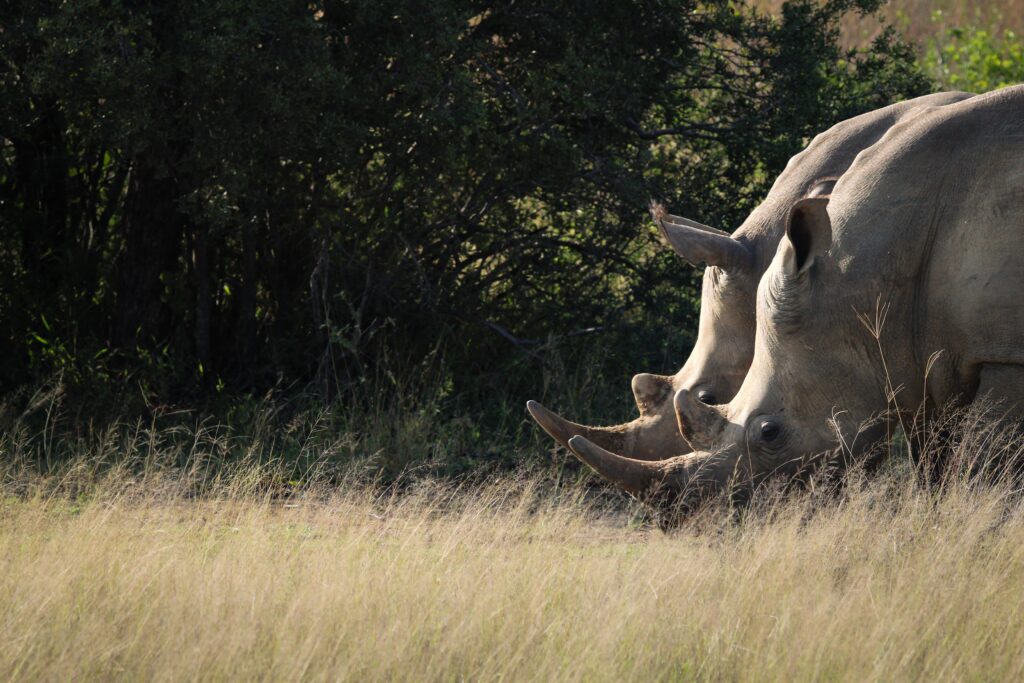
On a Laikipia safari, a rhino appears first as a shape in the grass.
Not a spectacle. Not a performance. Just weight and presence: grey hide, lowered head, the pale shoulder of Mount Kenya rising far behind it. The guide stops the vehicle before anyone reaches for a camera. For a moment, the country is quiet enough to hear the wind moving through dry seed heads.
This is Laikipia’s particular gift.
North and northwest of Mount Kenya, the land opens into high rangeland, private conservancies, working ranches, community-owned landscapes and river valleys where wildlife, livestock and people share space in ways that are complex, living and deeply consequential. Laikipia does not have the instant global recognition of the Maasai Mara. It is not built around one famous seasonal event. Its power is quieter and, for many sophisticated travellers, more interesting.
Here, safari becomes less about pursuit and more about placement: the right conservancy, the right guide, the right camp atmosphere, the right route through Kenya.
For Altivago travellers who value privacy, conservation intelligence, rare wildlife and elegant movement, Laikipia is not an alternative to Kenya’s classic safari story. It is one of its most considered chapters.
Is Laikipia Worth Visiting on Safari?
Yes — especially for travellers who want Kenya with more privacy, texture and conservation depth.
Laikipia is one of Kenya’s most important conservancy landscapes. The Laikipia Conservancies Association describes the region as a network of conservancies where tourism, conservation and community livelihoods are closely connected; the association itself was established to bring conservancies together and strengthen landscape connectivity.
For a traveller, that translates into a safari experience that feels different from a conventional reserve. Laikipia is not one gate, one loop or one style of camp. It is a mosaic of private and community-linked landscapes: Lewa, Borana, Ol Pejeta, Loisaba, Segera, Sosian, Mugie, Ol Lentille and other conservancies and ranches, each with its own character.
Some areas are strongest for rhino conservation. Others are better for horseback safaris, walking, wild dogs, Grevy’s zebra, reticulated giraffe, private houses, design-led retreats or helicopter access into Kenya’s northern frontier.
That is why Laikipia should not be chosen casually from a beautiful photograph. It should be matched carefully to the traveller.
Laikipia vs Maasai Mara: Which Is Right for You?
The Maasai Mara is Kenya’s great open-plains theatre: big cats, grassland drama, migration-season intensity and a wildlife language many first-time safari travellers immediately understand.
Laikipia is different.
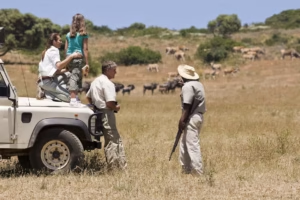
It is usually more private. The landscapes are more varied. The activities can be broader. The conservation story is often more visible. Instead of one dominant safari rhythm, Laikipia offers several: rhino tracking in golden grass, riding through ranch country, walking with expert guides, watching elephants beneath Mount Kenya, spending time with conservation teams, or flying by helicopter toward the deserts, lakes and escarpments of northern Kenya.
For many Altivago journeys, the strongest answer is not Laikipia or the Mara, but Laikipia and the Mara.
Together, they create one of Kenya’s most elegant safari structures: Laikipia for conservation, privacy and rare northern texture; the Mara for open-grassland wildlife and predator drama. The contrast makes both landscapes more memorable.
For travellers who already know the Mara, Laikipia can also stand beautifully on its own or combine with Samburu, the Matthews Range, Lamu or a private coastal retreat.
The Best Laikipia Conservancies for Different Travellers
Laikipia is not a single safari product. Its refinement lies in choosing the right part of the region for the right guest.
1. Lewa and Borana: refined rhino country
Lewa and Borana are among the most polished choices for travellers who want strong conservation heritage, excellent guiding and reliable rhino-focused safari. Lewa states that its rhino population has grown from an initial 15 rhinos to more than 280, making rhino protection central to its identity.
Borana, on the northern slopes of Mount Kenya, describes itself as a protected area committed to conserving wildlife and rangelands while supporting local livelihoods; it protects both black and white rhino within a 28,000-acre landscape.
This area suits honeymooners, families, photographers and travellers who want a sophisticated Kenya safari with a strong conservation foundation.
2. Ol Pejeta: conservation access and rare rhino history
Ol Pejeta is one of Laikipia’s most important conservation landscapes and is home to the last two remaining northern white rhinos. It also protects black rhinos and offers a more direct window into the practical realities of endangered species conservation.
For guests who want their safari to include a clearer understanding of modern conservation work — not as a decorative add-on, but as part of the journey — Ol Pejeta can be deeply worthwhile.
It is also practical for travellers who want strong wildlife, conservation education and relatively efficient access from Nairobi.
3. Loisaba: scale, northern drama and wild country
Loisaba brings a more expansive northern feeling. The conservancy describes itself as a 58,000-acre wildlife conservancy in northern Laikipia, with conservation, sustainable tourism and community development at its centre.
This is a strong choice for travellers who want space, wide horizons, elephants, big skies and a sense of moving toward Kenya’s wilder north. It can work well for active guests, photographers and families who want more than standard game drives.
4. Segera: design, privacy and contemporary African luxury
Segera sits on private land in Laikipia and is known for a more design-led, highly private style of safari. It is best suited to travellers who want space, art, wellness, conservation context and a refined camp atmosphere without needing to follow the most conventional safari pattern.
For private aviation clients, honeymooners or guests who want Kenya to feel highly personal, this style of Laikipia can be especially compelling.
5. Ranch and private-house Laikipia
Some of Laikipia’s most atmospheric stays are not about lodge grandeur at all. They are about houses, ranches, horses, dogs, long verandas, private guides and the feeling of being hosted inside a working landscape.
This is often the right fit for multi-generational families, repeat safari travellers and guests who prefer intimacy over formality.
What Wildlife Can You See in Laikipia?
Laikipia is especially strong for travellers interested in rhino, elephant and northern Kenya species.
Depending on the conservancy, guests may see black and white rhino, elephant, lion, leopard, cheetah, buffalo, Grevy’s zebra, reticulated giraffe, gerenuk, eland and wild dog. Not every species is equally likely in every area, which is why conservancy choice matters.
This is also one of the reasons Laikipia pairs so well with the Maasai Mara. The Mara gives classic open-plains density. Laikipia adds rare species, rhino country, ranchland, conservancy context and a different quality of light.
A good Kenya itinerary should not repeat the same experience in multiple locations. It should build contrast.
Why Conservation Feels Different Here
Laikipia’s conservation story is not abstract.
It is visible in ranger teams, rhino monitoring, community conservancies, grazing plans, wildlife corridors, anti-poaching work, research partnerships and the daily negotiation between land, wildlife, livestock and people.
Ol Pejeta’s northern white rhino story is globally significant. Lewa’s rhino work has grown over decades. Loisaba and Borana both speak directly about conservation, community and land stewardship in their operating models.
For Altivago, this is where luxury safari becomes more meaningful. A beautiful camp is not enough. The better question is: what landscape does this stay support, and how thoughtfully is the guest being brought into that story?
That does not mean every conservation claim should be accepted at face value. It means asking better questions before choosing where to stay.
Who owns or manages the land?
How are communities involved?
What conservation work is active, measurable and long-term?
How are guides trained?
How does tourism revenue contribute to protection, employment or land use?
The answers shape the quality of the safari.
How Many Nights Do You Need in Laikipia?
Three nights is the minimum for most Laikipia safaris. Four nights is often better.
With three nights, guests can settle into the landscape, enjoy strong game drives and include one or two specialist experiences such as walking, riding, conservation visits or a private sundowner in a remote part of the conservancy.
With four nights, Laikipia begins to reveal itself more fully. The guide has time to understand the traveller. The days feel less scheduled. A family can balance wildlife with rest. A photographer can return to a promising location in better light. A honeymoon couple can enjoy privacy without feeling they are missing the safari.
For private houses or active safaris, four to five nights can be exceptional.
Laikipia should not be treated as a quick add-on between the Mara and the coast. It is too interesting for that.
How to Combine Laikipia with the Rest of Kenya
The cleanest Laikipia journey usually begins with a soft arrival in Nairobi.
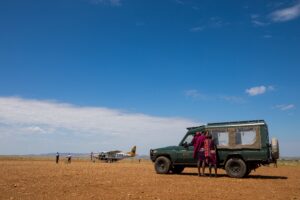
After a long-haul flight, one night in Nairobi can protect the whole itinerary. Guests rest, repack for light aircraft luggage limits and begin the safari without the strain of immediate onward travel. From Nairobi’s Wilson Airport, scheduled safari flights connect several Kenyan safari regions, with private charter available when timing, privacy or routing requires it. Safarilink, for example, lists daily Wilson–Maasai Mara services and identifies July to October as part of its high season.
From Nairobi, Laikipia can be reached by light aircraft into the relevant airstrip, or by private charter depending on the camp and route. Private aviation can also open more creative sequencing: Laikipia into Samburu, Laikipia into the Mara, or Laikipia onward to the coast with fewer compromises.
A strong Kenya structure might be:
Nairobi, Laikipia, Maasai Mara, Lamu or the Kenyan coast.
For repeat travellers, a more distinctive route might be:
Nairobi, Laikipia, Samburu or the Matthews Range, then Lamu.
For families, a private Laikipia house followed by a carefully chosen Mara conservancy can offer both ease and wildlife intensity. For honeymooners, Laikipia can create privacy and atmosphere before a beach ending. For photographers, it can add rhino, rare species and dramatic northern light before or after the Mara.
The mistake is trying to do everything.
A Kenya safari should move with purpose. Laikipia deserves a route that gives it room.
Practical Planning Notes for Kenya
Travellers should complete Kenya’s official Electronic Travel Authorisation before travel. The official eTA platform lists requirements including a passport with at least six months’ validity and one blank page, a passport-style photo or selfie, contact details, travel itinerary, accommodation confirmation and a payment method.
For Laikipia, the more nuanced planning decisions are not visa-related. They are experiential.
Which conservancy best suits the traveller?
Is the priority rhino, family space, walking, riding, privacy, design, conservation access or rare northern species?
Does the journey need a private vehicle?
Would a private house be better than a camp?
Should Laikipia come before the Mara, after it, or replace it entirely?
Is helicopter access worth building in, or would that overcomplicate the journey?
These decisions are where luxury becomes practical. They shape not only what guests see, but how the safari feels.
Who Should Choose Laikipia?
Laikipia is especially well suited to travellers who want Kenya beyond the obvious.
It works beautifully for families who need flexibility, space and more than repeated vehicle-based game drives. It is strong for honeymooners who want privacy without isolation. It is excellent for photographers who care about rhino, dust, mountain light, unusual species and uncluttered compositions.
It is also compelling for conservation-minded travellers who want to understand more of what protects a landscape: not only animals, but rangers, communities, research, grazing, land ownership and long-term stewardship.
For private aviation clients, Laikipia offers space and discretion. For repeat safari travellers, it offers freshness. For first-time travellers with enough time, it adds depth to Kenya’s classic safari circuit.
Laikipia is not for guests who only want instant spectacle. It is for those who understand that the most powerful safari moments are often quieter than expected.
The Altivago View
Laikipia is the thinking traveller’s Kenya safari.
Not because it is obscure. Not because it is more virtuous than the Mara. But because it asks better questions of a journey.
Where does the land begin?
Who protects it?
How does tourism fit into the landscape?
What does privacy allow?
How much should a traveller move, and where should they stay still?
In Laikipia, Kenya becomes layered: rhino country, ranch country, conservancy country, walking country, riding country, mountain-light country. It is a place of space and responsibility, but also beauty — spare, golden, tactile and alive.
For the right traveller, Laikipia may be the part of Kenya that lingers longest. Not because it was the most famous. Because it felt the most intelligently placed.
Altivago designs Laikipia safaris by matching each traveller to the right conservancy, guide, camp atmosphere and onward route — whether the journey continues to the Maasai Mara, Samburu, Lamu or a private coastal retreat.
For travellers considering Kenya beyond the obvious circuit, Laikipia is often where the conversation becomes most interesting.
Speak to our safari specialists
FAQs
Is Laikipia worth visiting on a Kenya safari?
Yes. Laikipia is one of Kenya’s most rewarding regions for travellers who value privacy, conservation, rare wildlife and varied safari activities. It pairs especially well with the Maasai Mara, Samburu or the Kenyan coast.
What is Laikipia known for?
Laikipia is known for private and community conservancies, rhino conservation, Grevy’s zebra, elephants, reticulated giraffe, wild dogs in some areas, walking safaris, horseback safaris, private houses and wide landscapes beneath Mount Kenya.
Is Laikipia better than the Maasai Mara?
Neither is simply better. The Maasai Mara is stronger for classic open-plains wildlife drama and migration-season intensity. Laikipia is stronger for privacy, conservation depth, rare northern species and a broader range of activities. Many refined Kenya safaris combine both.
Which Laikipia conservancy is best?
The best conservancy depends on the traveller. Lewa and Borana are excellent for refined rhino-focused safari, Ol Pejeta for conservation access, Loisaba for scale and northern drama, and private ranch or house-based stays for families and repeat safari travellers.
How many nights should I spend in Laikipia?
Three nights is the minimum for most travellers, while four nights is often ideal. Private houses, active safaris or conservation-led stays may justify four to five nights.
Can Laikipia work for families?
Yes. Laikipia can be excellent for families because many camps and private houses offer space, flexible guiding and varied activities beyond standard game drives. The right property choice is important, especially for younger children or multi-generational groups.
Does Laikipia combine well with the coast?
Yes. Laikipia can combine beautifully with Lamu, Diani, Watamu or a private coastal retreat, usually through Nairobi or carefully planned air connections. The result is a Kenya journey with conservation depth followed by a softer coastal ending.
Can you see rhinos in Laikipia?
Yes. Several Laikipia conservancies are important rhino habitats, particularly Lewa, Borana and Ol Pejeta. Rhino sightings depend on the conservancy, guiding, season and daily wildlife movement, but Laikipia is one of Kenya’s strongest regions for rhino-focused safari.